


 Posts


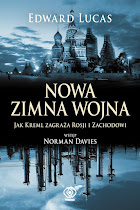


This is a (rough) transcript of my debate at CFR
#4
Council on Foreign Relations
www.cfr.org
February 22, 2008
Russia Update
Speakers: Edward Lucas, Central and Eastern
European Correspondent, Economist; Author, The
New Cold War: Putin's Russia and the Threat to
the West Stephen R. Sestanovich, George F. Kennan
Senior Fellow for Russian and Eurasian Studies, Council on Foreign Relations
Presider: Jack F. Matlock Jr., Adjunct Professor
of International Relations, Columbia University;
U.S. Ambassador to the Soviet Union, 1987–91
MR. MATLOCK: All right. Welcome to today's
Council on Foreign Relations meeting.
Please remember to turn off all your cell phones,
BlackBerrys and other wireless devices. And I
would like to remind members that this meeting is
on the record and we are being joined by a number
of our national members. So what we're doing is
being recorded, and eventually we will have
national members participate in the discussion.
Today I'm very pleased to introduce Edward Lucas,
who is the Central and East European
correspondent for The Economist, and has just
written a book: "Putin" -- "The New Cold War:
Putin's Russia and the Threat to the West." And
we have with us also Steve Sestanovich, as you
know, who is the George F. Kennan senior fellow
for Russian and European Studies at the Council here.
I'd like to start out by asking Mr. Lucas how he
views the current situation. I would say, sort of
briefly in Russia with the elections coming up,
is this is a stable situation or is it one which
perhaps is more friction under the surface than before?
And then a second that he might address is: Is
this election having any effect on our relationship?
MR. LUCAS: Well, thanks very much indeed, Mr.
Ambassador, for your kind words of introduction.
Thank you also to the Council for inviting me
here. It's a great honor to be able to address
both the people in the room and all the people
who are taking part of the event and from far away.
I think that the -- I don't like to use the word
"election" for what's coming up in -- (laughter)
-- election is a very good term for the --
(background noise) -- the feast of democracy
which we're seeing in America at the moment,
which is something which I think anybody anywhere
else in the world just looks at and wishes that
they could take part in this array of choices and candidates.
But in Russian, the word for election is vuibari
but that is -- (inaudible) -- choice and I would
call this a golosovaniye -- a voting. Just to
tell you, votes will be cast, but in a way that
would really, I think, befit the talents of a
great Russian novelist like Budarkhoff (ph), it's
both totally predictable and completely
mystifying. It's totally predictable, because we
know he's going to win -- Dmitri Medvedev -- and
it's totally mystifying because we have almost no
idea what it means. Is he keeping the seat warm
for Mr. Putin to come back -- maybe in years,
maybe even in months? Is he going to form some
kind of team of soft cop/hard cop relationship
with Mr. Putin? Does it mark a defeat for the
chekisti -- the siloviki in the Kremlin? Does it
mean that one clan is up -- the Gazprom lots are
up and the Rosneft lost out? We just don't know.
And terminology, which some people in this room
would have spent many decades practicing as a
skill for analyzing the Soviet Union in the
1950s, '60s, '70s and '80s -- and then went out
with the slide rule, carbon paper and the telex
machine -- for those of you who remember, the
telex was a hardwired, point-to-point low
bandwidth messaging system that predated e-mail.
Terminology seemed as dead as learning how to
sharpen a flint ax. And now, we're back. We're
using terminology again. We're trying to make
sense of the Shvartsman interview -- this amazing
interview in Kommersant, which gave us a little
clue into how the theft and reprivatization of assets is going on.
So yes, I think if he's not stable there is huge
fights going on behind the scene. We don't know
whether the guys fighting in the boat are
actually going to capsize it or they're just fighting in the boat.
And in terms of the relations with America, my
feeling is that all three candidates are going to
be tougher on the chekisti -- the Kremlin -- the
regime in the Kremlin than the Bush
administration has been. I think the people
advising them, from the language they're using, I
think that public opinion in America and other
countries is spooked by what's happening in
Russia and that sometimes the governing elites have got to catch up.
MR. MATLOCK: Steve, you?
MR. SESTANOVICH: Can I pick up on two points that Edward has made?
I agree "voting" is probably a better term than
elections. Elections do, however, create some new
uncertainty and some internal political dynamics.
And in Russia, that uncertainty usually leads
people to try to nail down everything that they
can, find ways of consolidating their hold on
assets and on influence that they've been able to amass.
Putin has presented Medvedev as a guarantee that
this doesn't need to happen, that there doesn't
have to be that much uncertainty. You can count
on predictability and stability in the future. It
has sort of taken -- I think that this unspoken
watchword of the new -- of the political
transition is going to be an old one. That is the
Brezhnevite phrase "stability of cadres." The
promise is everybody will be okay, but there is
plainly a lot of competition that has been
generated by the fact of an election.
I think the election has also had an impact on
Russian foreign policy -- or at least -- I would
say it has. And not -- and I think we should
notice that difference, as well as forecast what
might be the different approaches taken by
American leaders. The parliamentary elections in
the fall and the presidential voting this spring
have provoked a kind of heating up of Russian
political rhetoric toward the West, a desire to
animate Russian nationalist feeling.
You know, Russian political pollsters track
attitudes toward the United States. And what they
discovered is that starting -- there was a big
crash in Russian attitudes towards the United
States. It became much more negative during the
Iraq war and then they bounced back. And they
kept bouncing back, until last spring when Putin
gave his speech in Munich. And since then,
they've been on a downslide again and the Russian
leadership has pretty much been on a tear of kind
of anti-Western rhetoric, which Putin has led.
But Medvedev -- even though he has softened it
here and there -- has made clear he is pretty
much constrained by the boss's line. He says,
just as Putin does, if you look weak, people will take advantage of you.
And that's a kind of motto. There's -- I'm sure
there are Russian peasant folk sayings that
corroborate this view -- but it is now the view
of the elite. It's the definition of Russian foreign policy.
MR. MATLOCK: You know, I was struck by the title
of your book, "The New Cold War," and the reason
it struck me is that I spent 11 years in Moscow
between 1961 and '91, and most of them at the
height of the Cold War. And at that time we
really felt that the Cold War was not about
normal differences between great powers, but was
fueled by an ideology, a new -- I would say an
ideology which was universal in scope. We felt
that the Soviet Union was not a Russian empire
writ large but a communist empire with values
totally different from ours, whether they be
moral values or economic values, and that there
was an assumption at best that the system would
spread throughout the world and at worst that
they needed to help it do so and that that would increase their power.
And from that we had an arms race of tremendous
proportions. We had geopolitical competition at a
time when the Soviet -- and it was at its height
when the Soviet Union was most closed. When I
went to Moscow in '87 as ambassador and my fourth
time there, they were issuing I think about
1,300, 1,400 visitors visas a year and these
almost all to officials or a few small certified
delegations. We maybe got 2,000 or 3,000 refugee
visas for immigration. Before I left -- in fact,
while it was still the Soviet Union -- we were
doing 125,000 visitors visas and we had a waiting
list of half a million for immigration to the
United States, and then the barrier was not
getting out of the Soviet Union but getting in
the United States. I could go on and on but when
I looked at the sort of problems we have today,
and they are real, it seems to me that what we're
seeing is more sort of a normal friction between
sovereign states, particularly powerful ones,
rather than something that is a replay of the Cold War.
MR. LUCAS: Well, let me -- let me -- it's a very
fair point and it's one I address at the very
beginning of the book because I am not a veteran
of the Cold War like you but I was actively
involved in it in the 1980s, and I'm absolutely
not saying that the old Cold War is coming back.
That had three dimensions. You mentioned
military, ideology -- and it was global
confrontation -- this one isn't -- and the Soviet
Union then was a closed society. Russia is now
very well integrated inter -- both world
diplomatic structures and of course the economy
and constant human contact. I'm absolutely not
making that argument nor am I saying that Putin
is a new Stalin. That would be grotesquely exaggerated.
But what I am saying is that we have been much
too complacent, for a start, about both where
Russia is -- has already got to and what the
trajectory is -- that it sort of creeps up on us
and things that seemed unimaginable then became
isolated exceptions, then become -- happening
rather more often and then suddenly become part
of everyday life in Putin's Russia, and this has
really been extremely troubling and so one thing
I want to do is just give a wakeup call.
Secondly, I do think there is a tussle in central
Eastern Europe. These are countries which we
thought had been won for the cause. I don't use
the word democracy in the book because
democracy's such a slippery word. And in the --
having lived in the Soviet-occupied zone of
Germany which called itself the German Democratic
Republic I don't -- I'm always cautious when I
hear the word "democratic." But countries that we
thought had been won for political freedom, for
the rule of law, for the Euro-Atlantic
orientation we are now in severe danger of losing to sovereign democracy.
Now, I argue very strongly in the book that
sovereign democracy is a kind of ideology. It's
ideology that offers rich rewards for elites. It
frees them from the constraint and redress of our
rather more bracing system, and if you are a
politician in, say, Moldova that can look pretty
attractive. If you're a politician in Bulgaria,
that can look pretty attractive. If you're a
politician in Latvia or Lithuania, that can look
pretty attractive. And I travel these countries
all the time. I do not think we are winning and I
think in some cases we are losing under the
onslaught of Russian money washing in to these
countries still underdeveloped political economic
systems. And it goes further west.
And if I had sat here at the CFR six years ago
and said that a German chancellor, the heir to
Konrad Adenauer, Willy Brandt, Helmut Schmidt and
Helmut Kohl, would in his final weeks in office
sign off on an energy pipeline as controversial
as the Nord Stream pipeline, then a few weeks
later take a lucrative job as chairman of that
consortium you'd have said that was preposterous.
You'd have called security and wondered who on
earth is working for The Economist these days,
and that's exactly what Gerhard Schroder did. So,
you know, if you go down to Washington and look
at the money that's washing through K Street
there and the people -- you know, the people
who've got Russian clients and some of the other
activities going on this is not just an away
match. This is a home match as well. So in those
ways I am not saying it's the old Cold War
reprised but there is a severe conflict going on.
It's one that we are not winning at the moment.
MR. SESTANOVICH: Yeah, I agree with Edward and
Jack that the old Cold War is not the right
benchmark but we do have a new set of
disagreements with the Russians, and
understanding them is a challenge because they're
not what we expected really. The Russian
definition of them is they're correcting for the
humiliations and weakness that Russia experienced
in the 1990s and the -- anything that was agreed
starting after the death of Leonid Brezhnev, I
would say, is sort of ipso facto suspect. It was
probably forced on the Soviet Union or Russia
because of its weakness, and that means that
there's a kind of across the board reexamination
I think in a way that goes beyond really the
interest at stake that is -- involves national
pride, self- assertion. There is some kind of
weird combination in Russian foreign policy these
days between a nostalgia for being taken
seriously in the past in a way that they think
they weren't in the 90s and a desire to reject
the past and be a different kind of European
Western power, and they haven't really sorted out which that is.
But in the interim, the desire to overcome what
was agreed in the 90s I think has led to a kind
of bristly, even snarling style that isn't just
style. It has a kind of substance to it and I'll
give you two recent examples. One is just from
the past couple of days -- the way the Russians
have handled the Kosovo independence. Their man
at the -- at NATO has said, you know, this -- it
tears up the entire system of international law.
It may require us to use force. Putin has said
it's immoral and illegal and the result has been,
I think, you know, to stimulate violence that
they said they were not going to try to
stimulate. And they -- and the result is, you
know, the prime minister of Serbia, Kostunica, is
telling the crowds in Belgrade yesterday, "Putin
is with us." Now, you know, that is not the kind
of interaction that we expected.
A second one I'd give you is the way Putin talks
about an arms race in Europe. I was at a
conference last -- I'll get back to Putin in a
second -- I was at a conference in St. Petersburg
last summer where the first Russian speaker began
by noting that NATO had more tanks now than
Hitler did on the eve of Operation Barbarossa.
Well, what is your point? (Laughter.) But that's
common now -- this sort of sense that, you know,
we are really not in any way taking for granted
good relations. Putin talks about an arms race in
Europe that as far as I can tell is about one
thing. It's about these N interceptors and 10
radars that are going to be located in the Polish
and Czech Republics. It -- there's hardly
anything else to it. They pulled out of the CFE
treaty saying that the West is engaged in a
massive buildup while Russia's constrained. It's
-- there's something going on that I think does
take some new thought. I resist calling it the
new Cold War but I think it's something we didn't expect.
MR. MATLOCK: Well, whatever we call it, I think
if we are going to think about what we do about
it, it might be well to step back and say, well,
where are our interests? Where are our interests in dealing with it?
Now, I would submit that in the security area,
which does tend to trump everything else, there
is no threat to the United States that takes
precedence over the nuclear threat, particularly
the threat that proliferation could lead to terrorists having nuclear weapons.
I'm also convinced that we're not going to be
able to deal effectively without (sic) that
threat until we get the nuclear relationship with
Russia back where it was in -- at the end of the
'80s, the beginning of the '90s. We have seen the
whole process of reducing these weapons -- which
is an obligation under the Nonproliferation
treaty, fall victim to politics on other, in other areas.
We have now abandoned, at the United States'
insistence, the whole verification procedures
that took us years to work out, and which the
Russians were willing to accept. We walked away
from the ABM treaty even when they were offering
to amend it, and talking about a joint program --
which, in fact, is the only thing that makes any sense.
If you look at our own defense posture, you find
that words like "global dominance," and so on,
are very common. And it seems to me that somehow
we need to get that relationship back; to get
these weapons reduced -- their very existence is
a threat. And we're not going to be able to do it
unless we cooperate with the Russians in some way.
There are other, you know, concerns that I would
have, but I do put that first of all. And it
seems to me that some of the things that we're
doing, such as trying to build interceptors in
Poland, against missiles that don't even exist
yet; and pushing the button -- a psychological
one which, you know, in Gorbachev's time we
finally were able to work through, and that is
the Russian conception that missile defense is a
cover for an offensive strategy. It isn't true,
but it is felt very deeply there.
So this is pushing a button that is going to
cause all sorts of reactions. And I just wonder
if you agree that this is a priority, and if we
don't need a different way to handle it?
MR. LUCAS: Well, I'm aware that the nuclear issue
is one that divides people at the dais can't hear
enough about it. And those for who we -- the eyes
glaze over quickly -- (laughter) -- so I'm trying
to be both, sort of, brief and accurate and interesting, all at the same time.
I think that your -- I absolutely -- I absolutely
agree that we've mishandled the nuclear
relationship, and I argue in the book for a
different course. I think that it's, you know,
the Kremlin line is that Russia is a fortress
besieged by malevolent hypocrites. And everything
-- and anything we do that encourages that is bad
and gives comfort to the -- to the regime.
I think that one should -- we need to separate
out some of the issues a bit. And I think you're
absolutely right, -- is not -- it is not in
America's favor -- to America's advantage to have
a huge dominance in nuclear weapons because it
may make the Russians go over to launch on
warning. And that increases, at the very minimum,
the danger of a, of an accident. And I think
that's a rather basic point that perhaps this administration has not judged.
So I argue very strongly in the book that we
should engage with Russia on these big, strategic
questions. I think we always have to be careful
that our list of priorities don't turn into their
negotiating strategy. And there's always the
danger that we say what we really mind about is
this, much more than these things at the bottom
of the list. And they immediately think, well,
we'll give some promises on that thing up there,
and then we get Georgia, you know, as a prize.
And there's always -- you know -- so I think we
have to be quite careful about not giving away principles.
And I am arguing in the book for some quite sharp
measures on issues of democracy and human rights,
to put some distance between the past and
present. But, broadly, I -- you know, I couldn't agree with you more.
MR. MATLOCK: Steve, you know, I think we're all concerned --
MR. SESTANOVICH: Can I just say one word about --
MR. MATLOCK: Oh, Yeah.
(Cross talk.)
MR. SESTANOVICH: I think the -- my prediction
would be that the Russian-American relationship
will be, kind of, renuclearized in a way that
both of you have suggested. And I think the
administration has been kind of slow to take
advantage of some real opportunities that might exist there.
I mean, as far as I can tell, they don't even --
they have an, quote-unquote, "negotiation"
underway about the expiration of the START I
treaty next year, but they don't have a proposal
on the table. No proposal on the table means, to
me, not much of a negotiation -- (laughs).
However, I would just say I think there may be
some instrumental value in restabilizing the
relationship a little bit by reintroducing this
dimension. But I'm less confident about it than I
used to be, because I think their receptivity to
the idea that you can -- that you can introduce
a, kind of, basic stability in the relationship
by agreement on these -- on strategic nuclear issues. I think that's eroded.
MR. LUCAS: Yeah, I agree.
MR. SESTANOVICH: At any rate, you -- I just wanted to get in a word.
MR. MATLOCK: Very soon we should bring in the
members in the dialogue, but I was going to ask
-- I think all of us are disturbed by the
increasing authoritarianism, and many of the
problems we all see in Russia. But is there
anything, effectively, the United States, or for
that matter, the West can do to affect this as
long as Russians seem predominantly to be willing
to accept it? I guess that's one question.
Or, are attempts to make this an issue, perhaps
they even backfire given the current atmosphere.
What's your -- what's your feeling? Is anything
-- if we decide we should do something about it,
is there anything we effectively can do?
MR. SESTANOVICH: Yeah, it's a good question, and
I'll be really brief on it because I do want to
turn to the next phase of the discussion.
I think the phase of, sort of, Western commentary
on Russian democratic progress and human rights
performance is, sort of, over. The phase that we
began at the end -- toward the end of the Cold
War has, kind of, played out. And the idea that
there's a lot of influence, just in moral
opprobrium, is -- that one is not going to work
for us as it has. And it -- you know, we might as
well think of something, of something new.
If we're going to think of something new, the one
thought I would suggest, as this, sort of,
starting point for anything, is that it can't be
an American attack on, you know, Russia's -- you
know, the degree of Russian democratic virtue. It
has to be something more broadly agreed among
democratic states, and particularly the United States and Europe.
I would say that the administration, in general,
has been weak in trying to develop a consensus
with Europe about how to deal with Russia --
across the board, whether it's security issues,
economic issues, political issues, democracy. And
that is now, I think, recognized by the Europeans
as something that really does need to be on the
agenda of the -- for the U.S. and the Europeans
if they want to have any influence in the future.
MR. MATLOCK: I think it's time we should open up the discussion.
To members, if you would wait for the microphone,
and state your name and affiliation.
Let's see, Dr. Desai..
Q Thank you. I'm Padma Desai. I'm the Harriman
professor at Columbia University. Two questions:
You cited Bulgakov, one of my favorite authors.
The election, of course, is predictable, but mystifying.
Predictable: Dmitry Medvedev, the very personable
protege of Vladimir Putin, with 80 percent
popularity rating among Russians; you put up
three, four more candidates, it would still be
predictable, in my view. How would you react to that?
Mystifying? Why would it be mystifying?
Think in terms of Putin's legacy, which he's
passing on to his young protege -- the legacy
saying Russia -- Russian will determine which
way, in what pace, in what manner Russia will
evolve into a liberal system. This is his legacy. Would you agree with that?
My second question -- Cold War. I do not like the
title of your book, but that is your -- (laughter) --
MR. LUCAS: So long as you buy it, I don't mind. (Laughter.)
Q -- your privilege.
I mean, of course the Cold War was -- between the
two nuclear superpowers, there was a deterrent
which was operative. But the Cold War actually
was fought in poor Third World countries -- in
Vietnam, in Afghanistan, in Angola. Do you think
there will be a revival of that kind of a
scenario when you say, "Think of a new Cold War"?
Or do you see some kind of a robust pragmatism
which Putin has brought forward in his foreign
policy, maneuvering -- which he's saying, "Have
dialogue with us -- negotiate, negotiate,
negotiate because we have common interests?"
Russia, the United States, Western Europe,
nuclear nonproliferation, terrorism control,
bilateral nuclear downgrading -- isn't that -- I
mean, would you agree with -- what kind of Cold War scenario do you --
MR. MATLOCK: Thanks. Thanks very much.
MR. LUCAS: Look, I -- let me repeat again. I'm
not saying we've got the old Cold War back. I
mean, there is a little bit of what one might
call Russian mischief-making around the world in
places like Venezuela. But it is a pale shadow of
the Soviet Union's global reach and I'm
absolutely not arguing on that. So let me just put that out of the way.
I think for -- I would disagree, really, with the
-- on this basis of predictability and the other
candidates. We don't have a real political
contest because the only media that matters is
only reporting one candidate and, you know, I
think the opposition in Russia is extremely weak.
It's just the sort of opposition the Kremlin
would like, of no-hopers, never-weres, has-beens,
chancers, freaks. You know, this is the sad truth
of it. And the media -- you know, derides them
and -- but it also -- you know, it's not a system
that permits a real political contest.
And so -- you know -- I mean, I think with --
they could have put up, you know, the Kremlin
gatekeeper as a candidate. And he would have --
you know, with that kind of media coverage he
would -- you could make him look pretty good. You
know, Medvedev's clearly smart. I'm not saying
he's a nobody. But I think -- you know, one just
has to be realistic about this. It's not -- you
know -- and it is predictable. And I think the
idea that Russia is on a path to liberalism -- I
don't see it. You know, we have a mixture of the
red, the brown and the white. We have Soviet
nostalgia, Stalinist version of history, the kind
of youth movements -- all that. We have something
that might be called facism, a bit of brown. We
have a bit of white, which is, you know, the czarist era nostalgia.
Now is that going to go orange or is that going
to black? I don't know, but I wouldn't bet on it going orange.
MR. MATLOCK: Steve, do you want -- (off mike.)
Q I'm Timothy Towell, a retired Foreign Service type.
Why are we surprised about what Russia is doing
and saying, and what Putin is doing and saying?
The president of the United States looked in
Putin's eyes and saw his soul or whatever it was.
John McCain sees KGB, according to the New York
Times. That's fun. But we're talking about
Russia, Mother Russia, that fought against the
Teutonic Knights with Alexander Nevsky, Catherine
the Great, Peter the Great, winning the Russo-Jap
War, scaring the Brits by going into Afghanistan and --
MR. MATLOCK: Losing the Russo-Jap War.
Q Yeah, Russo-Jap War. (Laughter, cross talk.)
Trying to get -- yeah -- Mediterranean ports,
expanding into Eastern Europe -- why are we
surprised? What did we do in 1917? We did what
we're doing now, bagging money to the good guys
against the bad guys and we sent -- had
encouraged troops to go in there. It was called
capitalist encirclement. Do we have a new
capitalistic encirclement? How frightening for
Mother Russia to have Europeans go and take the
Baltics -- move into Poland, move into the
Ukraine. What is Stalin doing in his grave --
we're diddling around in Georgia, where Stalin
was born? There's a new term called pushback. Are
we surprised that there is pushback by this guy
that has KGB eyes? Is there anything surprising about this?
(Cross talk.)
MR. LUCAS: I really -- I really find that a bit
-- I mean, I find that almost outrageous to say
that Europe is pushing into the Baltics. I'm
sorry. The Baltics are European. You know, this
is just -- I mean, this is -- I mean -- and I
think this whole idea that Russia is somehow
entitled by its history to be an imperial power
and act in malevolent and destructive ways is
both untrue and very unfair on the Russians.
And I just -- can I just do a very quick quiz?
I'm just going to read out some names and I want
to see who's here, because that -- probably in a
way, the most important names in Russian history.
And we see who -- the first person to put their
hands up will maybe get a special inscription in their book, okay? (Laughter.)
Tatiana Baeva. Konstantin Babtsky. Larisa
Bogoraz. Vadim Dealunay. Any hands going up yet? Excellent. Okay.
It carries on just to say -- complete list, it's
Fainberg, Gorbanevskaya and Litvinov. Those are
the eight Russians who, with incredible bravery,
demonstrated in Red Square in 1968 against the
Soviet invasion of Czechoslovakia. They founded
-- is that Ken over there? Yes. They founded the
modern human rights movement. There should be
streets named after them. There should squares
named after them. There should be statues all
over Russia. And we should not allow Putin to get
away with his disgusting revival of the Stalinist
version of history, which says that
Molotov-Ribbentrop Pact was legal and was okay.
And when mainstream Russian media repeats that
the Katyn massacre was done by the Nazis and not
by the NKVD -- a lie that we thought was buried
in 1990 -- you know, I totally would resist this 100 percent.
MR. MATLOCK: Over -- back over here -- (laughter.)
Q Andy Nagorski, Newsweek.
Edward, I have the advantage of having your book
already -- (laughter) -- and as you know, I have
-- you have one statement in there which I think
is indisputable. It says -- you know, the G-8 is
supposed to be a group of industrialized
democracies. How does Russia fit in there in
terms of the definition of the latter word? Maybe
this will give you a chance to respond to the
last question, which I think Jack asked before
about what should the West's response be is the
implication there -- is -- should Russia be disinvited?
MR. LUCAS: Well, let me say yet again, I'm not
advocating a blockade of Russia or boycott or
Russian's isolation. Our best hope is the
continued integration of Russians in their daily
lives into the law-governed multilateral free
world. But we -- and I know the Council of Europe
is probably a body which occupies about 0.1
percent of your attention. But it is -- and it is --
Q On a good day. (Laughter.)
MR. LUCAS: -- in a year. (Laughter.)
And it is very -- it is the body which epitomizes
the post-Cold War democratic free law-governed
order in Europe. And we let Russia in in the
mid-1990s, when we were in an optimistic frame of
mind. It was probably the right thing to do, to
take that gamble. We suspended Beneroff (sp) on
what now seems like a technicality of a rigged
election -- a bit of restriction media freedom.
We know the country, which has revived the
practice of the psychiatric incarceration of
dissidents -- it's not just the rigged elections.
It's not just the assault on media freedom and
the venomous anti-western rhetoric -- Putin
describing America as the Third Reich -- this
explicit rejection of western norms as being
somehow not suited to Russia. So I think we have
to make a moral stand on that and say that Russia
can no longer be a member of the Council of Europe.
On the G7-G8 thing, what I would argue is that we
need a G12-13- 14 of big countries to talk about
global problems and Russia absolutely belongs in
there just as Brazil does, and perhaps even more
so as India does because that's not only big, but
democratic as well -- and China, all the rest of
them. So let's have a G13-14-15-16 -- whatever.
And if there's going to be a democratic -- a
caucus of democratic countries which maybe meets
the day before, that's fine, too and that can be
five, six, seven, eight, nine countries. Maybe
India should be in it. But Russia certainly shouldn't.
MR. MATLOCK: Yes. On this side, we'll try one. We'll come back here.
(Inaudible.)
Q Jim Dingman (sp), IMN World Report.
I'd like your assessment of how you discern the
differences and dissimilarities of the various
presidential candidates in the race towards their
policies towards Russia. And what is your
assessment of Putin's policies towards the Middle East at this point?
MR. LUCAS: Golly -- why don't you take that? (Laughter.)
MR. SESTANOVICH: Well, I haven't noticed that
Russia has been very high on the agenda in any of
the presidential debates, so it's been a little
hard to smoke out what the different candidates
think. It's been more a matter of the competing
one-liners -- you know, doing riffs on eyes and
souls and that sort of thing. Hillary Clinton has
had her own version of that. John McCain has. I'm
sure Obama will come up with one eventually.
And I think broadly speaking they have the same
kinds of concern about Russian -- about Russian
policy, stated in more or less similar
position-paper-sounding way, which gives you some
indication as to what an early administration
policy review would look like, but I don't think
it really tells you in detail what a new American
policy would be. I think it won't be the same as the current policy.
Russia and the Middle East -- there's a kind of
variety of Russian objectives that they want to
serve in the Middle East. And that involves
developing some loose gas OPEC; preserving good
relations with states that might be a source of
Islamic agitation inside their borders;
developing high-tech cooperation with Israel;
retaining a kind of seat at the diplomatic high
table when it comes to the roadmap for Israeli-Palestinian peace.
I don't think they're a particularly big player
in any of those games, with one exception that
matters a lot to the United States, and that has
been the effort to deal with the Iranian nuclear
program. And there I think there's a kind of
schizophrenia in the Russian policy, which isn't
so different from their schizophrenia on some
other issue. And that is: Do they want to align
themselves with the Europeans and the United
States to add to outside pressure on Iran to take
a different course; or do they want to be a
separate diplomatic entity which can broker deals
between the Iranians and the West -- at the
expense of possibly reducing pressure on Iran?
And they just haven't really sorted that out. You
know, they said, well, we're dealing -- we're
sending fuel to the Iranians to start up their
reactor. Doesn't sound good, but then they say,
and we're managing -- we have arrangements to
perpetuate or preserve that Russian presence
there under joint venture. Sounds like it could be good.
I think they are uncertain as to whether they
want to be part of the West on this issue, or
separate so as to maximize their role.
MR. MATLOCK: Yes.
Q Bob Lifton, Medis Technologies.
There's a huge difference between the Cold War
and today is Russia's economic position --
particularly with respect to energy and the
energy they control and gas and the leverage they
have with that energy and that gas.
Would you comment on that in relationship to your view of the Cold War today?
MR. LUCAS: Yes. Well, it's a very interesting
contrast. In a way, Russia is a sort of shrunken
husk of the Soviet Union in terms of its part.
But on the other hand, they have used one of the
remaining Soviet assets -- the monopoly on
east-west gas pipelines -- rather effectively.
Now, in a way that's very odd, because Europe is
so much bigger, freer, stronger, more attractive,
richer than Russia. Why is the Gazprom tail
wagging the European dog? And the answer is that
European collective bargaining, collective
security on energy lacks credibility and it's
therefore very tempting for countries to go and
do their own bilateral deals with Gazprom,
allowing Gazprom to buy downstream assets in
Western Europe and entrenching the vertically
integrated energy monopolies there.
In a way that's really quite alarming. And you
know, I list in the book -- I think, you know, I
mean just in Western Europe you've got Italy,
Austria, the Netherlands, Germany all doing, you
know, doing deals with Gazprom. And what's left
of the European energy promise of building the
Nabucco pipeline looking, you know, it's turning
into just a kind of a pencil line on a map. And
it's a big -- you know, it's one of the big
recommendations that I'm making is that we have
to get our act together on that, because if we
don't we just -- it's -- (speaking in foreign language).
MR. SESTANOVICH: Can I have one thing on this?
I do think that the Europeans' inability to
actually develop coordinated policies that they
can enforce in the area of energy is a very
revealing weakness of how little the Europeans
have actually advanced toward being the kind --
you know, a nation state style player in international affairs.
But I do think that U.S. policy has been very
negligent here in not trying to play a role to
add to -- to increase coordination among the
Europeans. It basically treated energy as a
European problem and that seems to me to have had predictable consequences.
Q Bruce Gelb, Council of American Ambassadors.
Mr. Sestanovich, I think you characterized
Russian policy as having to do with you have to
look strong, otherwise no one takes you seriously.
Yesterday I took somebody seriously when I looked
in the papers and saw the picture of the American
embassy in Belgrade in flames. And the comment
that you made coming out of Belgrade that Mr.
Putin, in effect, is on our side leads me to the
question: How much involvement do you believe
Russia is going to have in the next week, two --
or month or two -- in terms of dealing with the
Kosovo problem and Russia's position relative to Serbia?
MR. SESTANOVICH: I'm afraid it looks as though
it's going to be larger than they had said --
made us think in advance. They've gotten a little
carried away by the sort of drama of the moment.
You know, there's famous phrase of the prince of
Montenegro in the 19th century: We and the great
Russian people are 150 million strong. (Laughter.)
I mean, in the end I don't think it's going to
help Serbia very much that Russia is on their
side, but the Russians are certainly stoking the situation up rather seriously.
MR. LUCAS: If I could add a bit very briefly on that.
I don't think Russia really cares about Serbia at
all, but it's a wonderful way for them to --
sorry -- to do things that they like. It's a bit
like missile defense. They don't really care
about missile defense, but it's a good way of
dividing Europe and separating Europe from
America, and that's exactly what they've got over
Kosovo -- some European countries recognizing,
others not and quite a lot of Europeans -- quite
wrongly, in my view -- blaming the whole thing on
American intervention to support Kosovo in the first place.
So Russia's policy is very opportunistic. It's
not -- this is not principled Slavic solidarity,
but it is proving quite effective -- at least in the short term.
MR. MATLOCK: Yes, the gentleman here.
Q David Phillips from Columbia University.
No speeches here, just a quick question about Russian-Georgian relations.
The Russian government was threatening to draw a
parallel between the West's recognition of Kosovo
and its potential recognition of Abkhazia and
South Ossetia. Given its full-throated support
for international law, it doesn't look like
that's going to be the case. Do you agree?
MR. LUCAS: Yeah.
Q And how do you think that Russian and Georgian
relations are going to go forward, given the
continuing nuisance of the Georgian president in Moscow?
MR. LUCAS: Well, I think it's -- first of all,
Russia -- I think Russia will not recognize any
of the three puppet states, because it's too
dangerous for Russia. Russia has far more --
(background noise) -- more, as they put it,
separatism. It's the principle of ethnic
self-determination. It's very threatening to them.
What they are doing quite effectively is using
South Ossetia and Abkhazia to try and provoke the
Georgians into doing something stupid. Now, I
would like to say that the Georgian president is
a very levelheaded man with a wide circle of
advisors who ponders deeply before taking
decisions and very rarely puts a foot wrong, so
therefore this track is not going to succeed.
Unfortunately, I can't say that with as much
confidence as I would like. (Laughter.)
MR. MATLOCK: Yes. The lady here.
Q Thank you.
MORE
Joanna Weschler, Security Council Report. Like my
neighbor here I haven't read, unfortunately, your
book yet but I spend a lot of time watching the
Security Council of the U.N. as my organization's
name indicates and I wanted to ask you -- and I
don't know whether this is addressed in the book
-- whether or not you are also worrying about the
new Cold War taking place in security issues and
specifically in the Security Council because my
own observations would indicate that we are
perhaps going back -- we are not there yet but
going back towards something resembling the Cold
War dynamic in the Council, and some members
canceling themselves out and just being stalled.
MR. LUCAS: I hope you're -- I fear you're right.
I hope you're wrong. Steve maybe would answer in more detail.
MR. SESTANOVICH: Well, I think there's definitely
a trend in that direction but I wouldn't
exaggerate the contrast between this decade and
the 90s, for example. In the 90s, it was because
the Russians were clearly going to veto any
resolution on Kosovo or before that on other
Yugoslav issues that you ended up having NATO
take decisions on its own without a -- without
any U.N. -- without any agreement within the
Security Council, and the same pattern was more
or less evident on issues involving Iraq. You
were not able to get Russian support, and some of
those cases -- some of those stalemates involved
rather similar motives from ones that you have
today -- commercial or nationalist.
We had -- we had that kind of -- we've seen that
deadlock before. What's different now is the --
is the desire not merely to, you know, stand
their ground in disagreement with Western
positions in the Council but to -- I mean, the
case of Kosovo I think take a much more
inflammatory line than they did in the past.
Remember, the Russians participated in diplomacy
to try to end the war. Right now I would say the
approach seems somewhat different.
Q Thank you. Tony Holmes, the Cyrus Vance Fellow
here at the Council. With regard to what Dr.
Sestanovich said a few minutes ago about Russia's
role as a nuclear supplier to Iran and harking
back to what you said earlier about the lack of
present engagement between the United States and
Russia in terms if its own denuclearization, do
you think it's possible to marry the two issues
and to try to get a creative new avenue to engage
with the Europeans and Russia on the
denuclearization or the dismantlement of Iran's
nuclear program by starting off with a
considerable denuclearization on part of both
Russia and the United States and doing what the
rest of the world believes we've already
committed to do in terms of the nonproliferation
treaty, and use that as a means to attack the Iran issue?
MR. SESTANOVICH: It sounds good but I wouldn't
hold out too much hope for it. It seems to me it
puts a lot of weight on the idea that the
Iranians will play ball when they see the other
major powers united against them. There might be
some greater inclination on the part of the
Iranians to feel under pressure but they -- you
know, a couple years ago when Putin floated his
proposal to handle enrichment for the Iranians
outside of Iran, the Iranians, you know, played
him along and eventually convinced the Russians
that they were just dealing totally in bad faith
on this and so the Russian initiative kind of
collapsed. There are a lot of elements of this
that one could try to put together. I would be
inclined to think there might be more hope of
using nuclear issues to kind of stabilize the
rest of the relationship although as I said
earlier I think they're -- I have less confidence
in that than I used to. But I wouldn't expect a big payoff in the case of Iran.
MR. MATLOCK: I have one over here. This is
probably going to be the last question.
Q Jeff Laurenti with the Century Foundation. I
wonder if you could tell us to what degree there
has been pushback from within Russian society at
this gray reversion to Stalin-era fairy tales, if
I may use that term, about cutin (ph), about --
and about the whole history of the Soviet era,
and to what extent is the West -- Europe, much
less the U.S. -- in any position to try to steer
back to an emphasis on human rights and facts in
the face of what appears to be a concerted effort
-- is it from the top or from the old nationalist
sector, so-called grass roots in Russian society,
that has been pushing the reversion to the
fictitious history of the mid-20th century?
MR. LUCAS: Yes. Nice cheerful note to end on.
(Laughter.) I think in a way this is one of the
front lines of the new Cold War is the fight over
history and to try and rebut this, and there are
things we can do and a lot of it's on the
Internet. You know, in the old Cold War, we used
short-wave radio to try and get our message
across and they could block that. It's much
harder to block the Internet. And if you read
Russian, even more so if you can write in
Russian, I do recommend you to go onto the
Russian language Wikipedia, for example, and look
at the talk page on things like cutin, Molotov,
Ribbentrop, Stalin, Estonia -- you know, every
bit of contested -- because the arguments are
happening right there and I think we can -- and
we can both get in and make our point. And I also
think there's more we can do to get all the
historical documents that are available online.
PDF them -- make them available so that enquiring
minds in Russia can just reach out and see that
there is an alternative version.
And also, if you do read Russian I do recommend
that you try and get hold of the some of the
modern history textbooks. It is really alarming
and this is as if you had, you know, German
textbooks saying that the Anschluss and the
Munich Treaty were legal and leaving out the
Holocaust. You know, this is really, really
dangerous stuff and I -- as a final note, I mean,
I -- when I'm feeling optimistic I think they --
the people in the Kremlin are just corrupt and
they've just invented this whole nationalist
hooey in order to justify stealing tens of
billions. When I'm feeling more -- when I'm
feeling more pessimistic I think they actually
believe it. But either way, it is leaching into
the Russian mindset and it's going to be some time before it works itself out.
MR. SESTANOVICH: One sentence to add to that
that's separate from the issue of historical
truth -- it's just do -- are there Russian
criticisms of the foreign policy which raises
doubt as to whether this has been productive or
successful. There are not very many but there are
some, and you can read them in the Russian media,
by the way. The -- you know, Russian newspapers
are full of criticisms of -- which are allowed
because not very many people can read them --
criticisms cautious but nevertheless firm about
the tone and style and content of Russian foreign
policy, particularly on some of the European
issues that we've talked about, raising a
question as to whether they really advance
Russian interest. But these are very much at the margin.
MR. MATLOCK: I think we have maybe time for one
more if it's very short. (Laughter.)
Q Vill Vannon (sp), Roosevelt Institute. Do you
accept that the missile threat from Iran
justifies our proposed action in Czechoslovakia and Poland?
MR. LUCAS: Well, it's an interesting question.
I'm reminded a little bit of the cruise missile
argument in the 1980s -- that there was this
feeling that there was a -- it would -- this
would kind of emphasize America's commitment to
Europe by putting medium range missiles in. It
actually came with Helmut Schmidt's request in a
way with the best of intentions. It ended up with
dividing Europe and stoking anti-Americanism. And
I feel a bit the same about missile defense. I
mean, obviously the threat is a long way away.
One can argue that some of the lobbying for this
is done by companies that will make money out of
it and my own feeling if I was American I'd be
more worried about Iran sending a war -- a
nuclear device by FedEx than I would by sending
it through a missile. But leave that aside --
clearly the Russian hysteria about this, I think,
is actually preposterous. They're far more
worried about China and they're far more worried
about, you know, Muslim demographics than they're
actually worried about NATO. It's a great issue
for them because as I said before it allows them
to divide Europe and stoke anti- Americanism.
Q But is it preposterous -- excuse me -- is it
preposterous for the Russians to react by saying
that it -- since there is no threat, there must be another purpose?
MR. LUCAS: Well, with a new --
MR. SESTANOVICH: Yes. Yes. I'll just give you a
simple answer to that. Yes, because it's -- it is
so fragmentary. It has no ability to, as the
Russians constantly say, neutralize their
deterrent. We're talking about 10 interceptors.
The idea that because of that you're going to be
targeting which, you know, I really can't --
cannot see the military significance of vis-a-vis
the Russian's strategic nuclear deterrent. It's
tiny. It is -- I mean, I'm not -- it really might
not be adequate even for a future Iranian threat
but it surely has no relationship to a Russian
threat which is, you know, which involves missiles --
MR. MATLOCK: Well, what they worry about is the
foot in the door and also as I've said it was
very clear when we were discussing SDI the
Russian conception of it is quite different. They
really do see it as a cover for something
offensive. This happens not to be true but we
should be dealing with perceptions.
MR. LUCAS: But unlike --
MR. MATLOCK: And when there is no need for it --
and there is no need for it -- it can only be
seen as essentially a provocation by the
Russians. And I think, you know, I think that's why they're --
MR. SESTANOVICH: It's not that that can only be
seen this way. It's that they have to make a
decision about how they're going to see it --
MR. MATLOCK: Oh, sure.
MR. SESTANOVICH: -- and they've decided to see it
in a different way and to really exaggerate the
threat in a way that I think they -- they understand the choice.
MR. MATLOCK: Yeah. Well, that's right. Other people never exaggerate threats.
I think we better -- (laughter) -- I think we
better close with this. Thank you very much. It's
been great. (Laughter, applause.)
*******
Monday, February 25, 2008
| [+/-] |
CFR discussion transcript |
Saturday, February 23, 2008
| [+/-] |
More NCW stuff |
The Warsaw Business Journal has interviewed me here
I was at the Council for Foreign Relations at a lunch chaired by Jack Matlock and in discussion with Steve Sestanovich. You can see video excerpts here (though not the bit where I explode with anger in response to a pro-Kremlin, anti-Baltic comment)
The Guardian has printed a largely flattering review.
You can read a (rough) transcript here of my event at Radio Free Europe/Radio Liberty or if you really want listen to the whole 90 minutes of it here.
I had some tough criticism from Andrew Kuchins during the event (also 90 minutes) at the CSIS. You can listen to it here
I was plugging New Cold War on an American (NPR) Radio programme called Fresh Air. You can listen again here
And on Here and Now, another NPR radio programe here
I was on C-Span on the same subject. You can watch it here
And you can see most of Russia Today's attempt to ridicule the book here
| [+/-] |
Sergio |
United Nations
A brave man's journey
From The Economist print edition
|

TIMID bureaucrats not headstrong brainboxes may leap to mind when United Nations officials are mentioned. But Sergio Vieira de Mello, who was killed when jihadists blew up his UN headquarters in Baghdad in 2003, was an exception. Samantha Power's detailed and sympathetic biography tells the tale of a Brazilian expatriate whose world outlook was shaped by the left-wing idealism of Paris in 1968 but then tempered by ever-increasing doses of reality.
By the end of his life, Vieira de Mello had junked the Marxism and anti-Americanism of his youth, as well as the niceties of UN procedure. He saw law and order as a vital adjunct of peacekeeping; he believed international intervention worked only if it was cloaked in legitimacy; and that it was always necessary to engage with the worst people in a conflict, if only to see how best to neutralise them.
The book provides a thoughtful account of the conflicts and disasters that changed his mind. These stretched from Lebanon to Cambodia, from Rwanda to ex-Yugoslavia, from East Timor (his biggest success) to the post of UN human-rights commissioner and, finally, to catastrophe in Iraq. He was on the scene during the dying spasms of the cold war and the birth pains of the new American century: cajoling parties to the conflict, wheedling outsiders for money and fuming at the leaden, out-of-touch officials back home.
Ms Power, a professor at the Kennedy School of Government, describes Vieira de Mello as “brave but enigmatic”. He was willing to do things and go to places that most international bureaucrats would have found too risky: bringing the Khmer Rouge to the negotiating table was a high point. In the blurry world between humanitarian aid and international law he was as good as it gets, wielding a mixture of ambiguity and decisiveness with the personal and institutional authority to make it all, sometimes, work.
As a person, he remains a bit of a puzzle. He was a great womaniser—in a way that perhaps seems more scandalous now than it did in the 1970s—yet he stayed married to a faraway wife for two decades. He was an arch pragmatist, but remained idealistic about the UN's goals. He was a brilliant leader of a small team, but bad at managing a big one. He seems to have relied heavily on charm.
A striking lesson from the biography is the incompetence that surrounded Vieira de Mello after he was blown up. As he lay trapped in the ruins, rescuers tried frantically with their hands to shift the rubble. What they needed were planks to stabilise the debris and jacks to lift it. All that came too late. The UN, which had previously failed to blast-proof the windows of a headquarters under imminent threat of attack, was then too stuffy to fly his Baghdad-based Argentine fiancée all the way to his memorial service in Brazil.
| [+/-] |
Europe.view column |
Europe.view
The case for clarity
From Economist.com
Why does the EU support independence for Kosovo?
WHY is the West giving Kosovo independence when it refuses to recognise Transdniestria, South Ossetia and Abkhazia? These three places are nominally independent—at least in their own eyes—and have been so for many years.
At first sight it seems a clear case of Western double standards. Kosovar Albanians don’t want to be under Serbian rule any more than the Abkhaz feel Georgian or the Transdniestrians like Moldova. They have established their status by force of arms, and entrenched it over ten years of quasi-independence. Is not the real story just an American power-play in Europe, punishing Serbia and rewarding the only pro-American Muslims in the world?
Nobody would deny that such political calculations have influenced decision-making. But the real difference is another one. Kosovo wants to join the European Union. That much is at least clear, however badly run Kosovo may be at the moment, and however much gangsterism and ethno-nationalism have flourished there under the haphazard stewardship of the so-called international community. Kosovo does not want to join, say, Turkey in a new “Ottoman Caliphate”. Nor is it even interested in forming a “Greater Albania”.
That makes a big difference. Transdniestria, Abkhazia and South Ossetia do not subscribe to the Euroatlantic vision of multilateral security and law-governed political freedom. The main priority of the ruling elites there is self-enrichment, followed by at least a rhetorical commitment to closer integration with Russia (a goal that the Kremlin endorses in theory but seems remarkably cautious about in practice).
The West is reluctant to say so bluntly, but that makes a difference. The EU is sending thousands of lawyers, prosecutors and police officers to Kosovo, in what might be termed the continent’s most ambitious colonial adventure for decades. That “soft imperialism” creates at least a chance of success for Kosovo’s independence.
All this may yet be derailed. Bosnia is falling apart again; Macedonia still looks fragile; and Russia could not ask for more fertile soil for mischief, with Europe divided and indecisive. But it is worth a try.
Contrast that with Transdniestria or Abkhazia. Imagine that Russia and a bunch of other countries—Belarus, Uzbekistan, Armenia and Venezuela, say—decided to go ahead and recognise these breakaway statelets. It is almost laughable to imagine what such outside supporters could offer to promote the rule of law and good government. Would Hugo Chávez of Venezuela offer policemen? Would Russia provide prosecutors, or Uzbekistan start teaching Abkhaz civil servants about e-government?
This is the weakness at the heart of all the Kremlin’s foreign-policy efforts in the countries of the former Soviet Union. It offers a great deal for elites. Some enjoy lavish hospitality and lucrative directorships. Others get intelligence co-operation and sales of advanced weaponry.
But Russia has much less to offer from the public’s point of view. True, it offers passports, and a Russian passport is not worthless.
But the survival of the Soviet-era propiska system means that this does not confer the prized right to live and work in Moscow. Even the Kremlin’s most loyal allies can’t offer that to their citizens as a quid pro quo. (Admittedly, Schengen and American visas can still be shamefully hard to come by, even for citizens of ex-captive nations that are loyally Euroatlantic in outlook).
What the EU will not say, but thinks privately, is this: We are supporting Kosovo’s independence because of the chance that it will become more like us, and hence a better neighbour. We oppose independence for Transdniestria et al because it would make them more like Russia, and therefore worse for Europe.
Friday, February 15, 2008
| [+/-] |
Newsweek review |
The stellar Andy Nagorski has reviewed NCW here
"a meticulously constructed indictment of Putin's strong-arm tactics at home and his increasingly aggressive tone in dealing with his immediate neighbors and any other countries that try to question his behavior."
| [+/-] |
e-govt leader |
| | ||||||
| ||||||
 | ||||||


Technology and the public sector
Government offline
From The Economist print edition
Why business succeeds on the web and government mostly fails
| |
 | |
IN ONE respect at least, it has been a huge success. Selling new technology to governments has brought private contractors a bonanza of many tens of billions of dollars in the past ten years. Although putting information on the web (call it “i-government”) has worked, our special report shows that “e-government”—using the interactivity and speed of the internet to provide public services—has so far mostly meant high costs and poor returns.
Why is government unable to reap the same benefits as business, which uses technology to lower costs, please customers and raise profits? The three main reasons are lack of competitive pressure, a tendency to reinvent the wheel and a focus on technology rather than organisation.
Governments have few direct rivals. Amazon.com must outdo other online booksellers to win readers' money. Google must beat Yahoo!. Unless every inch of such companies' websites offers stellar clarity and convenience, customers go elsewhere. But if your country's tax-collection online offering is slow, clunky or just plain dull, then tough. When Britain's Inland Revenue website crashed on January 31st—the busiest day of its year—the authorities grudgingly gave taxpayers one day's grace before imposing penalties. They did not offer the chance to pay tax in Sweden instead.
Globalisation provides some substitute. In India, where things too often are still done in triplicate, Andhra Pradesh's pioneering e-seva system lets people pay their utility bills, transfer money, buy railway tickets and so on. Now other parts of India are trying to catch up. In Dubai, public agencies compete to impress the country's go-ahead sheikh, who praises the best and humiliates the laggards.
But shame and beauty contests are still weak forces in the public sector. Failure in bureaucracy means not bankruptcy but writing self-justifying memos, and at worst a transfer elsewhere. Bureaucrats plead that just a bit more time and money will fix the clunky monsters they have created. That kind of thinking has led to the botched computerisation in Britain's National Health Service, where billions of pounds and millions of precious hours are spent on a system that at best will be substandard and at worst dangerously leaky with patients' private medical data.
That reflects another problem. In the private sector, tight budgets for information technology spark innovation. But bureaucrats are suckers for overpriced, overpromised and overengineered systems. The contrast is all the sharper given some of the successes shown by those using open-source software: the District of Columbia, for example, has junked its servers and proprietary software in favour of the standard package of applications offered and hosted by Google.
One ground for hope is that bureaucracies can piggyback on the private sector's experience. Rather than invent new online security systems for the public sector, why not use those already developed by banks, as in Scandinavia?
Interestingly, the examples of good e-government in our special report have a common factor: a tough-minded leader at the top, willing to push change through against the protests of corrupt or incompetent vested interests. It would be nice to think that democracy would do that, concentrating voters' preferences for good government and creating an electoral ratchet in favour of modern, efficient public services. It hasn't happened yet. The paradox is that if you want really efficient e-government, you are more likely to get it in semi-feudal Dubai than in most of the world's biggest democracies.
 |
|
| Copyright © 2008 The Economist Newspaper and The Economist Group. All rights reserved. |
|
|
Thursday, February 14, 2008
| [+/-] |
cee economies update |
Eastern Europe's economies
Coming in to land
From The Economist print edition
The east Europeans swap one economic problem for another
ORTHODOX economics suggests that big current-account deficits, high inflation and fixed exchange rates are a lethal combination. But after a scary year, the east European countries that looked most likely to tumble seem to be heading for a softish landing. In Estonia growth has dropped from double digits to a mere 4.5%. In Latvia retail sales, rising by as much as 25% last summer, are growing by only 10%. The foreign banks that own most of the financial system in both countries have tightened lending. Even if some housing borrowers default, the pain is manageable.
The European Commission continues to fret, particularly about Latvia. It gave warning this week of a “hard landing” if the government does not tighten fiscal policy again. But Neil Shearing of Capital Economics in London says that only the collapse of a big bank in the Baltics could prompt a crisis that would break the local currencies' peg to the euro.
Most other countries in the region have floating exchange rates. Many have raised interest rates recently—by a full percentage point in Romania—to head off inflation. Price rises endanger both competitiveness and their chances of adopting the euro. Hungary has the lowest growth and the highest inflation in central Europe; its currency, the forint, has been sliding. “If America has stagflation-lite, Hungary has stagflation-heavy,” says Mr Shearing.
Markets are proving remarkably tolerant of the east Europeans' diminished zeal for reform after their rush to membership of the European Union. With labour costs still a small fraction of the euro area's, the prospects for growth look good on the surface. But worries about longer-term competitiveness are growing. Employment rates are still low—at 50%, Poland's is the second-lowest of any economy in the EU. But like its predecessor, the centre-right government in Warsaw shows little appetite for painful structural reforms.
The most solid prospect in the region now is Slovakia, thanks to the rigorous (and unpopular) policies of the previous government. Slovakia hopes to adopt the euro in 2009; the EU is scrutinising the figures now and will give its verdict in April. Soaring foreign investment and strong growth have stoked tax revenues, cutting the budget deficit. Slovakia's problem is inflation. It should fall to 2.7% this year, which is tiny by other countries' standards, and comfortably under the EU's target for euro membership—but it reflects artificial (and unsustainable) one-off controls on energy prices.
Countries that have pegged their currencies to the euro, or are shadowing it, lose their independence in monetary policy without gaining all the benefits. Willem Buiter, a former chief economist at the European Bank for Reconstruction and Development, thinks some would do better to adopt the euro unilaterally. The European Central Bank and European Commission would hate this, but they could not stop it, he argues.
You can hear the full interview with Willem Buiter on "Economist Radio" here
| [+/-] |
Nabokov review |
Vladimir Nabokov
Imagination ablaze
From The Economist print edition
|

IMAGINARY conversations with dead people are risky materials for a book, as are authorial comparisons with geniuses. So Nina Khrushcheva, great-granddaughter of the Soviet leader, Nikita Khrushchev, and herself an émigré Russian intellectual, is doubly ambitious in her slim volume of autobiographical literary and political reflections on Vladimir Nabokov, believed by many to be the greatest Russian writer of the last century.
She is ambitious too in her panoramic and sometimes dizzying sweeps through two centuries of Russian culture and politics. The reader who opens the book and finds references (on a random two pages) to Tertz, Pushkin, the Mnemosyne, Koncheyev, Godunov-Cherdyntsev, Brodsky and the “bamboo bridge” between poetry and prose could be forgiven for feeling intimidated. If he happens then on the sentence, “I saw myself in many ways walking in Nabokov's footsteps,” he might even sense a whiff of impudence.
But Ms Khrushcheva's approach is both accessible and modest. A self-deprecating tone saves her from pretentiousness. And from her opening contention, that “Nabokov's journey from obscure Russian émigré writer to the author of American and world literary classics is essential for understanding Russia's past, its present and its future”, she wears her learning lightly. If you are not quite sure at the beginning of the book who Pushkin was and why he matters, you will know enough by the end to appreciate her finely drawn comparisons and contrasts between these two towering literary figures, and feel only mildly miffed by the publisher's sloppy omission of an index, or any pictures of the places she so eloquently describes.
Ms Khrushcheva's central point is that Nabokov bridges the gap between tsarist Russia (mystical, feudal and isolated) and the West far better than either the forced modernisation of communism, the chaotic shock capitalism of the 1990s or the authoritarian self-confidence of the Putin era. Nabokov, she says, presents the future of Russia for this century: a place that balances both the “indifference of democracy” and “heroes of kindness” such as perhaps his greatest character, Timofei Pnin (an émigré academic who is both besotted with America and at sea in it).
That reflects the two great dilemmas in Russian intellectual life: reconciling the horrors of the past with the potential of the present, and defining Russia's relationship with the West. The first of these is hampered by scanty foundations: Russia's rulers have shown an unpleasant taste for persecuting the brightest and best, sending them into exile, or simply having them murdered. That makes it all the harder to find a firm foundation for confident engagement with the West without surrendering the spiritual and emotional qualities of which Russians are justly proud.
Nabokov and his works, Ms Khrushcheva explains, taught her “Westernisation”: how to be an individual in a place that lacked a state ideology to provide form and meaning to life. “How to be a single ‘I’ instead of a member of the many ‘we’ in that vast undifferentiated traditional collective of the peasant commune, the proletarian mass, the Soviet people, the post-communist Rossiyane [Russian nationals]...He kept his soul without having to remain backward in order to do so.”
Fired up, Ms Khrushcheva returned to Moscow in 2001, hoping to share this gospel with literature students, only to find she was too late. Nabokov was already the flavour of the age. Her students could quote his works by heart. “They found the 19th-century writers too dramatic, too pathetic, and those of the 20th century too critical, unhappy and dissident. Post-communist literature is too trashy. But Nabokov is just right!”
That didn't survive Putinism (another sign of her country's impatience for bad short-cuts, she reckons) but inspired her to write this excellent book, and to dedicate it to the great Abram Tertz. That is a good choice. Tertz was the pen name of Andrei Sinyavsky, sentenced to seven years' hard labour in 1966 for the crime of publishing literary criticism abroad. Protests on his behalf by Andrei Sakharov and others marked the birth of the Soviet dissident movement. His “Strolls with Pushkin” 30 years ago was criticised by many for being insufficiently reverential. Ms Khrushcheva's imaginative memoir may be too. That is all to its credit.
| [+/-] |
Invisible gas business |
Europe.view
What is it for?
From Economist.com
Cutting out the middleman in Ukraine
TO CONNOISSEURS of financial euphemism, the RosUkrEnergo website is without peer. A company that appears to own no reserves or pipelines made a stonking $785m in the gas business in 2006 (the last year recorded) and more than doubled its assets, from less than $2 billion to more than $4 billion.
It would be outrageous to suggest that anything underhand is going on—after all, RosUkrEnergo is audited by blue-chip PricewaterhouseCoopers and is associated with the ultra-respectable Raiffeisen bank. But shareholders in Gazprom may reasonably wonder why their company has outsourced the evidently lucrative business of buying gas cheap in Russia and central Asia, and selling it dearly to Ukraine.
Add to that puzzling corner of post-Soviet capitalism an array of vast and baffling debts, supplies from one of the world’s worst dictatorships, plus a casual threat of nuclear retaliation and you have the humdrum world of Ukrainian-Russian energy relations.
| |
 | |
Source of trouble |
Once again, Gazprom has threatened to cut off Ukraine because of overdue bills, and once again the issue has been fudged.
The Kremlin is clearly, and deplorably, trying to intimidate Ukraine into dropping its newly revived ambitions to join NATO, and to quashing any thoughts that it might host American missile-defence installations. Vladimir Putin’s loose talk about nuclear targeting is particularly alarming. But real point of the story is bad government and corruption.
It is a huge indictment of Ukraine’s post-independence rulers that their incompetence, crookedness and ruthlessness has after 17 years left the country with no independent source of gas imports and such wasteful patterns of consumption. That was not inevitable.
As Georgia has shown, necessity is the mother of both thrift and invention. When mysterious explosions inside Russia cut the gas supply to Georgia in 2006, the economy there did not collapse: instead the authorities quickly restored a decrepit Soviet-era pipeline from Azerbaijan, and industry started using energy a lot more efficiently. Economic growth has rocketed.
Ukraine should take the same medicine—and better voluntarily now, than being force-fed it by the Kremlin at some point in future. The proposed White Stream pipeline, bringing gas to Ukraine across a corner of the Black Sea, is an ingenious plan that deserves top-level political support.
As the planned Nabucco pipeline through Turkey and the Balkans seems finally to have been stymied by Russian machinations, White Stream may now be the best hope not only for Ukraine, but also for Europe, of securing an independent supply of gas from the Caspian, the Caucasus and Central Asia.
It is also time to accept higher gas prices. A gas shortage is looming in Russia, aggravated by the cynical but extravagant notion of extending gas supplies to tens of thousands more households. Gas from Turkmenistan is supposed to fill the gap, though whether enough will be forthcoming is wholly unclear. The sooner Ukraine’s booming economy gets used to world prices, the stronger its position to haggle for whatever exports are available.
But the biggest change should be to dump the notion that intermediary companies in international gas trading are necessary or desirable.
Ukraine’s prime minister, Yulia Tymoshenko, is no stranger to this world: in her earlier career as a businesswoman, she worked closely with Itera, a predecessor of RosUkrEnergo. But she is right to insist that her country’s gas imports should be transparent now rather than later, and it is troubling that Viktor Yushchenko, Ukraine’s president, has been dithering on the issue. The working group that he has agreed to set up with Russia needs to ask some simple but tough questions (for example: who exactly owns RosUkrEnergo?) and then draw the obvious conclusions.
| [+/-] |
e-govt audio interview |
You can here an Economist audio interview about my 12,000-word special report on e-government here
| [+/-] |
Daily Mail piece on Badri |
Analysis: Fear of the super-rich Russian fugitives
By EDWARD LUCAS - More by this author » Last updated at 23:52pm on 13th February 2008The scene would be a fitting start to a novel by John Le Carré. A mysterious foreign tycoon is found dead in his Surrey mansion. On the surface, it looks like a heart attack.
But within hours the fingers of suspicion are pointing to warlords from Chechnya, acting as contract killers, or to the ruthless and sophisticated assassins of the Kremlin.
It is a fair bet that until yesterday, few people in Britain had heard of Badri Patarkatsishvili, and even those who did hesitated before trying to pronounce his tongue-twisting name.
Genial and ruthless, he epitomised the world of post-Soviet business, where mysteriously-gained fortunes could be used to topple governments and settle scores.
Scroll down for more...

Friends under threat: Patarkatsishvili with Boris Berezovsky
Mr Le Carré might think it a plot twist too far, however, to put the investigation of a renegade Georgian tycoon in the hands of the Surrey Major Crimes Investigations Unit, more used to dealing with small-scale racketeering in Weybridge than international murder plots.
Even the sharpest Russia-watchers and spycatchers of Britain's security services, the latter-day heirs to George Smiley, find it hard to unravel the feuds, rivalries, interests and alliances of this country's ex-Soviet super-rich. And that's the way the oligarchs who have made their homes in Britain like to keep it.
Most guard their privacy jealously. Roman Abramovich, once the Kremlin's in-house banker but now only an occasional visitor to Russia, has a motto: "Money likes peace and quiet".
His famous reluctance to give interviews is in sharp contrast to his former friend, and now bitter foe, Boris Berezovsky.
Wanted for fraud in Russia, Berezovsky - who was with Patarkatsishvili on the day of his death - strikes many British officials as a nuisance because of his repeated attacks on Vladimir Putin and the ex-KGB officers now running Russia.
More typical are the rich Russians who arrive by private jet and are whisked from the VIP lounge to their closely-guarded mansions in Hampstead and Surrey.
They spend liberally on lawyers, PR men and financial advice - but if they have views on politics in Russia, or indeed anything else, they wisely keep their thoughts to themselves.
Russia's super-rich might like holidaying in France and banking in Geneva, but London is still by far their preferred place to live.
One reason is a strong - some might say quaint - belief in the ability of British justice to protect their property from seizure and themselves from extradition to Russia.
The Kremlin has repeatedly asked the British authorities to send Berezovsky back to stand trial but successive governments always say no.
The reason, it is rumoured, is that Berezovsky brokered a deal in 1999 to release two British hostages held in Chechnya.
In return, he was promised that should he need safety in Britain, he would have it, and Britain has honoured that pledge to the fury of the Kremlin.
To be on the safe side, the Russian Londonchiki (Londoners) employ the most advanced security systems money can buy.
Visits to their offices involve body searches, security scans and scrutiny by some of the best bodyguards in the world. Some are veterans of the French Foreign Legion. Other Russians prefer to buy British, opting for the understated menace of former SAS men.
The lifestyle that these muscular, taciturn watchers protect is both enviable and claustrophobic. Nothing is spontaneous: a restaurant visit means booking not one table but half the room, with lookouts posted at the door and in the kitchen. Favoured transport is the £500,000 Maybach limousine - with armour plating, bulletproof windows and independent air supply.
London is good for family life too: children can go to the top private schools (Millfield and Wellington for the dimmer ones, Winchester and Westminster for the brainboxes).
A new day school in Knightsbridge, central London, has opened on the specific promise of high security for the children of the super-rich.
Even so, some find any kind of schooling too risky for their offspring, opting for private tutors to the relief of many public-school headmasters who find the Russian clientele's lavish spending and disregard for rules a source of grief.
London is also becoming the world capital for glamorous Russian-speaking women. Mistresses can be kept safely and conveniently, while wives can be let loose on the boutiques of Sloane Street and Mayfair.
Local friends are few and far between. Russians in particular tend to prefer old friends to new ones, even among compatriots. British forms of socialising, such as the dinner party, strike them as offputtingly-formal. The language barrier- many of the Londonchiki speak only limited English - presents a problem too.
Those Britons who do bridge the gap are cherished. Prince Michael of Kent, who speaks impeccable Russian, is a particularly welcome guest.
So too are a handful of British investment bankers who served in Moscow in the 1990s when many Russian super-rich made their fortunes.
long this will last is an open question. An increasingly xenophobic Kremlin looks with disdain at Russians-with a penchant for lavish lifestyles in exile.
And whether or not Patarkatsishvili was murdered, many super-rich (and not only from Russia) regard the prospect of dealing with the British tax authorities as on a par with assassination or extradition.
More pertinently, if the death proves to be the work of political assassins, it will be the second such death on British shores following the poisoning of Alexander Litvinenko.
Even in their luxurious British fortresses, it seems, there is no guarantee of safety for the oligarchs in exile. It might be time to move on to an even more secretive playground.
In the boutiques of Geneva, the staff would do well to be studying their Russian dictionaries.
• Edward Lucas is author of The New Cold War, Bloomsbury, £18.99
| [+/-] |
NewInterviews |
Economist Radio has an interview with Timothy Garton Ash, aka "Mr Europe" and also with Ilmars Rimsevics, governor of the Bank of Latvia
And you can watch my interview on Newsnight, the BBC TV evening current affairs show here
Tuesday, February 12, 2008
| [+/-] |
Review from New York Sun |
 | |
February 7, 2008 Edition > Section: Opinion > Printer-Friendly Version
Putin's New Cold War
BY DANIEL JOHNSON
February 7, 2008
URL: http://www.nysun.com/article/70910
LONDON — So you thought the Cold War was over, did you? Welcome to Vladimir Putin's new Russian Empire.
Using the wealth generated by soaring oil and gas prices, the Kremlin has intimidated its former satellites in Eastern Europe, while treating most of America's North American Treaty Organization allies as if they too could be pushed around.
Russian revanchism for the supposed humiliations of the Yeltsin era in the 1990s drives this agenda. President Putin calls the collapse of the Soviet Union the "greatest geopolitical catastrophe" of the twentieth century, and the suggestion is that everything that has happened since 1991, or even 1989, should now be reversed.
The Russian bear is now throwing his weight about in the international arena, inciting riots in neighboring states or cutting off energy supplies where the Kremlin feels its interests and prestige are at stake.
Whether this campaign of bullying is comparable to the Cold War is a matter of huge importance to the West. Hence it matters which experts we pay attention to.
One whom I can unreservedly recommend is Edward Lucas, an authority on the subject who has been covering the region since the 1980s and has for many years been the Central and Eastern Europe correspondent for the Economist. Mr. Lucas has just published "The New Cold War: How the Kremlin Menaces Both Russia and the West" (Bloomsbury).
Mr. Lucas pulls no punches in excoriating the Putin regime. He is a brave man to stick his neck out so far. In Russia, journalists have been murdered for saying less than he claims in his book.
But "The New Cold War" is extremely — indeed, overwhelmingly — persuasive about the fate that has yet again befallen the unfortunate region of Europe that lies on the borderlands of East and West. For Mr. Putin's Russia, "repression at home is matched by aggression abroad." Whether it is targeting missiles at NATO countries or actually firing them at Georgia, Moscow has no compunction about using brute force to achieve its aims.
The most worrying factor in the situation is not, however, the attitudes of the most part fiercely independent states in the Baltic, Caucasus, or Central Europe. It is the tendency of the wealthy countries at one remove from Russian power, but dependent on Russian energy supplies, that really gives cause for concern.
Knowing how to play what Mr. Lucas calls "pipeline politics" is really the only contribution that Mr. Putin has made to Russian foreign policy during his eight years in office. But it has yielded political as well as economic dividends, despite the notorious inefficiency of Russia's state-run energy monopoly, Gazprom, whose chief executive, Dmitri Medvedev, is Mr. Putin's anointed successor.
During the period after September 11, when America was preoccupied with the Islamofascist threat to the virtual exclusion of others, West European leaders mostly cozied up to Mr. Putin: notably Jacques Chirac of France, Gerhard Schröder of Germany, and Silvio Berlusconi of Italy. Mr. Schröder even stooped so low as to accept a job from Gazprom immediately after leaving office.
During the past year or two, there has been a change of leadership and a notable hardening of tone: Chancellor Merkel of Germany and President Sarkozy of France have both talked tough to the Russians. But the energy dependency of Europe has increased if anything, while Russia's successful attempts to diversify its customer base in the far east has strengthened its bargaining in position.
Russia may call the shots in its acrimonious relationship with NATO, but the real economic power still lies with the West. "The free market cannot be decoupled from the free society," Mr. Lucas states. As long as Europe and America do not abandon the small, weak states in Russia's sphere of influence, they can prevent the new Cold War from spiralling out of control.
The Cold War was all about beating the Soviet Union at its own game, while keeping a clear sense of the ideological and moral gulf that separated the two systems. The Lucas thesis is in essence a plea for "a renewal of both that moral competition and moral distance."
In the War on Terror, the West's greatest enemy is itself, as in the Cold War. "Until we make it clear that we believe in our own values," Mr. Lucas argues, "we cannot defend ourselves against the subversion and corruption that are leaking into our citadels of economic and political power."
That's the point: we must believe in our own values. If we who have lived by this Judaeo-Christian moral code — including freedom, democracy, and the rule of law — do not proclaim it and fight to preserve it, why should the Russians, who have lived under one form of despotism or another since time immemorial, suddenly adopt it as their own?
Whether it is defending itself against Islamofascism or Putinism, the Atlantic alliance must believe in its own mission before it can win the war of ideas.
February 7, 2008 Edition > Section: Opinion > Printer-Friendly Version
Monday, February 11, 2008
| [+/-] |
Guardian piece plugging book |
Putin's playground
Russia's leader and his cronies have crippled every constraint on their ugly brand of capitalism
- Edward Lucas
- The Guardian,
- Monday February 11 2008
Capitalism is amoral, verging on the immoral. What makes it tolerable is constraint and redress. Voters, consumers, shareholders, public officials, lawyers, legislators, journalists and pressure groups are counterweights to the ruthless and narrow pursuit of private profit. That doesn't work perfectly in the west, but it doesn't work at all in Vladimir Putin's Russia, where the fusion of political and economic power is complete.
The ex-spooks and their business cronies have launched a unique experiment in state capitalism, where the same people run both ministries and the industries they regulate, where markets are opened and closed according to the political clout of the participants, and where the rule of law and rights of the individual mean nothing.
The rough political pluralism of the 1990s had flaws, but it has given way to something far worse. Putin and his colleagues have crippled every constraint and removed every means of redress for the wronged. Opposition parties are marginalised; elections are like televised wrestling, a sham contest between carefully vetted contestants. The victory of Dmitry Medvedev in the presidential election on March 2 is as inevitable as it is puzzling. Nobody doubts he will win; nobody knows what he will be like in power or how long he will stay there.
The Duma has become a mere sounding board for the authorities. Every organ of state is harnessed to do the Kremlin's bidding. The judiciary, police and other supposedly independent bodies have become part of what Lenin referred to as the "transmission belt". But instead of communist ideology, the Kremlin now promotes "sovereign democracy" - a ragtag mixture of xenophobia, nationalism, mysticism and self-righteousness, buttressed with the sort of rhetoric that points to "a new phase in the arms race", as Putin said on Friday.
Civil society has been neutered. Any body receiving western funding attracts official displeasure. The bland culture-mongers of the British Council, hauled from their beds in the middle of the night to answer for the "crime" of working for foreigners, are just the most prominent casualties of the squeeze.
In 1990s Russia, under Boris Yeltsin, the crude pluralism of the media meant nobody was above criticism. Now draconian law and forced changes of ownership mean every national television channel, most newspapers and all but one radio station toe the official line.
The harshest treatment is reserved for individuals. Some, like Anna Politkovskaya, are killed. More often, the story is of intimidation, of conscription into the army for young men such as Oleg Kozlovsky, leader of an anti-Putin youth group, or incarceration in psychiatric hospitals, as has happened to Roman Nikolaichik, an opposition activist.
Nor does Russia come under any external constraint. It flouts the rulings of the European Court of Human Rights. With foreign debts paid off and the Kremlin kitty stuffed, foreign donors and creditors have no leverage. Indeed, now Russia's firms romp through the capital markets in London and New York aided by lawyers and bankers who, when it comes to selling a stolen oil company, see not a jail cell but a bonus.
Old cold war hawks have long been bristling about Russia's soaring defence budget and bullying of western darlings like Estonia and Georgia. But criticism from the left has been oddly muted, partly thanks to Putin's self-depiction asa counterweight to a US "unipolar world" exemplified by Dick Cheney and oil-driven military adventures. Yet their days are numbered: US democracy is wriggling out of the Bush administration's grip. A far uglier face of capitalism lies to the east, not the west.
· Edward Lucas is the author of The New Cold War: How the Kremlin Menaces Russia and the West
Sunday, February 10, 2008
| [+/-] |
new reviews |
I will be talking and signing books at Politics and Prose in Washington DC on Sunday 17th Feb at 5pm.
Here is Marcus Warren's review in the Sunday Telegraph
And here is Tom de Waal's in the Sunday Times
I will be on the BBC Newsnight programme on Tuesday 2230 plugging the book and on BBC Radio 3 Nightwaves on Thursday


